
Couple Yoga Before Conception: Preparing for Parenthood Together

By Dr. Nutan Pakhare
Preparing for conception is often approached as an individual journey—one partner focuses on nutrition, lifestyle, health, yoga or medical preparation, while the other may remain in the background.
But conception begins with two people.
It is a shared decision, a shared responsibility and, ideally, a shared journey.
This is where couple yoga can offer a meaningful dimension to preconception preparation. Beyond physical postures, couple yoga creates an opportunity for partners to pause, connect, communicate and become more aware of each other.
At AYG Academy, we believe that yoga during the preconception period should not be limited to physical preparation. It can also create space for emotional awareness, conscious partnership and shared intention.
What Is Couple Yoga?
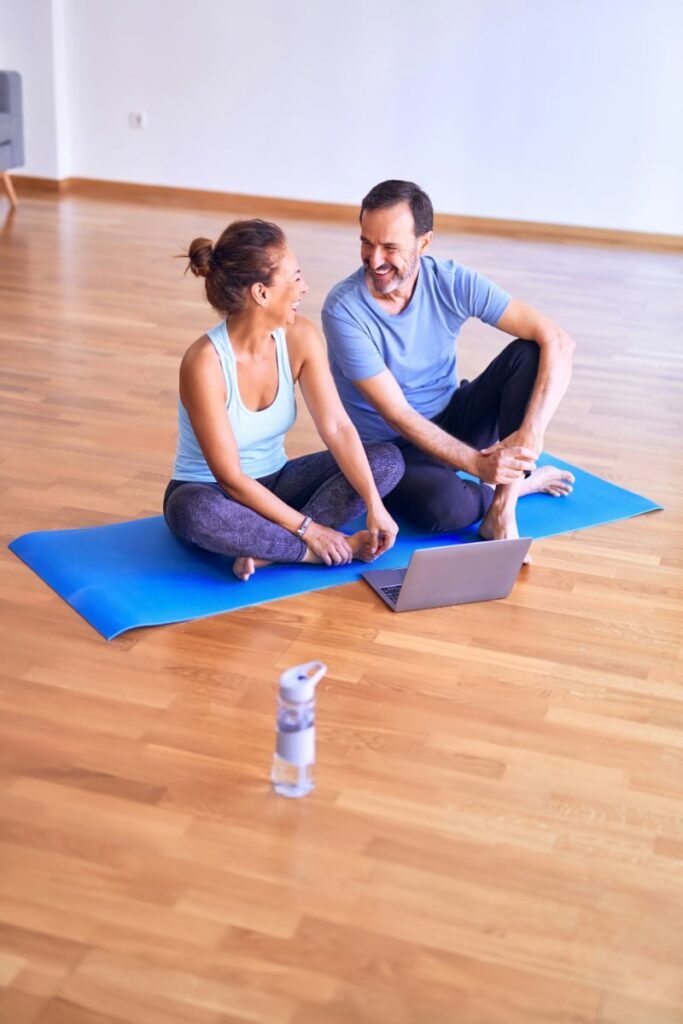
Couple yoga is not simply two people performing yoga postures next to each other.
There is an important difference between practising beside someone and practising with someone.
When a couple practises together, attention naturally expands beyond one’s own body and breath. The practitioner begins to notice the partner—their pace, breathing, comfort, strengths, limitations and emotional state.
The practice becomes collaborative.
Instead of asking only:
“Am I doing this posture correctly?”
The couple begins to ask:
“Are we both comfortable?”
“Are we breathing together?”
“Can we support each other?”
“Are we both present in this experience?”
That shift can transform the quality of the practice.
Begin With Intention, Not With Asana
One of the most valuable learnings from a couple-yoga experience is that the practice can begin even before the first posture.
Before starting, partners can take a moment to talk about why they have chosen to practise together.
What do we want from this practice?
Do we want to feel more connected?
Do we want to reduce stress?
Do we want to improve communication?
Do we want to consciously prepare ourselves for parenthood?
A shared intention creates a sense of direction.
It also reminds the couple that they are not merely completing another yoga session. They are creating a small space in which they can listen, connect and participate together.
From Individual Awareness to Relational Awareness
Traditional yoga practice encourages awareness of the body, breath and mind.
Couple yoga adds another dimension: awareness of the other person.
During a partnered practice, we may become conscious of our partner’s:
-
breathing pattern
-
pace of movement
-
physical comfort
-
strengths and limitations
-
confidence or hesitation
-
emotional responses
-
need for support or space
This does not mean constantly monitoring the partner.
Rather, it means developing a gentle sensitivity towards the person with whom we are practising.
This is an important quality in any partnership.
Balance Is No Longer About “Me”
Partnered balancing practices can offer a beautiful metaphor for relationships.
When practising alone, the question may be:
“How long can I hold my balance?”
In couple yoga, the question changes:
“How can we both remain balanced?”
Sometimes one partner may need more support. At another moment, the other partner may need it.
The practice can therefore become an embodied experience of mutual support, adaptation and trust.
It reminds us that partnership does not always mean doing the same thing at the same time. Sometimes it means adjusting ourselves so that both people can participate safely and comfortably.
The Role of Communication and Consent
Physical proximity does not automatically create intimacy.
Conscious communication does.
Couple yoga provides opportunities to practise simple but important skills:
Communicate.
Ask.
Listen.
Respect.
Adapt.
Support.
Consent becomes particularly important when physical contact or assisted movement is involved. Each partner should feel comfortable with the practice and have the freedom to communicate discomfort or say no.
This creates a foundation of trust.
And trust is not only relevant on the yoga mat. It is an important part of the journey towards parenthood.
Beyond the Physical Body: Emotional Awareness
A couple’s interaction is not purely physical.
During a partnered practice, different emotions may arise—hesitation, vulnerability, amusement, frustration, affection, insecurity or even discomfort.
The purpose is not to suppress these emotions.
Instead, the practice can encourage partners to notice what is arising without allowing the emotion to overwhelm the interaction.
This creates an opportunity for greater self-awareness and interpersonal awareness.
The couple learns to remain present, communicate clearly and continue the practice with mutual understanding.
Synchronising Awareness, Not Just Movements
Perhaps one of the deepest insights from couple yoga is this:
Couple yoga is less about synchronising movements and more about synchronising awareness.
Two people may perform exactly the same movement and still be completely disconnected.
Conversely, two people may move at slightly different speeds and yet be deeply connected through awareness, communication and mutual support.
The real synchrony is therefore not necessarily physical.
It is mental, emotional and relational.
How Can This Support the Preconception Journey?
Preparing for conception is more than preparing the physical body.
It can also be a time for a couple to consciously consider:
-
Are we ready for this journey?
-
Are we communicating openly?
-
Are we supporting each other?
-
Are we able to express our concerns and expectations?
-
Are we making this decision together?
-
How can we care for each other’s emotional wellbeing?
Couple yoga cannot answer these questions for a couple, nor should yoga be presented as a substitute for appropriate medical care.
However, a thoughtfully designed practice can create a pause for connection and reflection.
Instead of moving mechanically towards conception, the couple gets an opportunity to become more conscious of the journey they are choosing together.
The Teacher’s Role: Understand Before You Instruct
This experience also highlights an important principle for teachers of preconception and couple yoga:
Do not begin with the practice. Begin by understanding the couple.
Before introducing couple yoga, a trained teacher should consider the couple’s:
-
stage of preconception preparation
-
physical condition
-
emotional state
-
individual needs
-
relationship dynamics
-
comfort with physical contact
-
communication style
-
expectations from the practice
Every couple is different.
A practice that is appropriate for one couple may not be appropriate for another.
Therefore, the teacher’s role is not simply to demonstrate partnered postures. It is to create a safe, respectful and inclusive environment in which both partners can participate comfortably.
The teacher should explain why a particular practice is being introduced and how it may support the couple’s overall preparation.
Only after understanding the couple should practices be selected according to their individual and combined needs.
From Yoga Practice to Conscious Partnership
The deeper value of couple yoga lies beyond the posture.
It can become an opportunity to practise qualities that are essential in partnership:
Communication.
Consent.
Patience.
Trust.
Mutual support.
Emotional awareness.
Presence.
These qualities cannot be cultivated through theory alone.
Sometimes, they need to be experienced.
A simple balancing posture can teach us to support rather than compete.
A coordinated breath can teach us to slow down and listen.
A moment of physical contact can teach us about boundaries and consent.
And a shared intention can remind us that the journey towards parenthood belongs to both partners.
AYG Academy’s Perspective
At AYG Academy, our approach to prenatal, postnatal and Garbhasanskar education is rooted in the understanding that pregnancy preparation is multidimensional.
The body matters.
The mind matters.
Emotions matter.
Relationships matter.
And the environment in which a child is welcomed into the world matters too.
Couple yoga can therefore be viewed as one meaningful component of conscious preconception preparation—not as a performance of difficult postures, but as an opportunity for two people to become more aware, connected and intentional in their shared journey.
Because ultimately, preparing for conception is not only about preparing two bodies to create a baby.
It is also about preparing two individuals to become partners in parenthood.
And perhaps that is the most beautiful lesson couple yoga can offer:
Do not simply practise beside each other.
Learn to breathe, listen, support and grow together.