
5 Lessons Every Mom-to-be Can Learn From Captain Smit

By Dr. Nutan Pakhare
What a cockpit crisis and a labour room have in common — told through the 4 P’s I teach in my course: Power, Passenger, Passage, and Paying Attention.
खुदी को कर बुलंद इतना कि हर तकऽदीर से पहले, खुदा बंदे से खुद पूछे, बता तेरी रज़ा क्या है
— Raise your inner self so high that, before every destiny unfolds, God Himself turns to His servant and asks: tell Me, what is it you will?
_____________________
Picture a cockpit, thirty thousand feet above the ground. Something has gone badly wrong. The instruments are telling a story no pilot wants to read. And in the middle of that chaos sits one man, Captain Smit, with a cabin full of people whose lives now depend entirely on what he does in the next few minutes.
He doesn’t have the luxury of panic. He doesn’t have the luxury of waiting for someone else to decide. All he has is his training, his instinct, and — as it turned out — his faith.
I think about that cockpit often. Not because I fly, but because I have been teaching this very subject — childbirth — for almost a decade now, and I have come to believe that what happened up there and what happens during childbirth are closer than most people realise.
In my course, I teach mothers that labour comes down to four things — the 4 P’s: Power, the strength behind every contraction. Passenger, the baby making their way into the world. Passage, the birth canal opening to let that passenger through. And Paying Attention, the mother’s own awareness of her body, her breath, and her baby, moment to moment.
Captain Smit’s cockpit had all four. So will your delivery room.
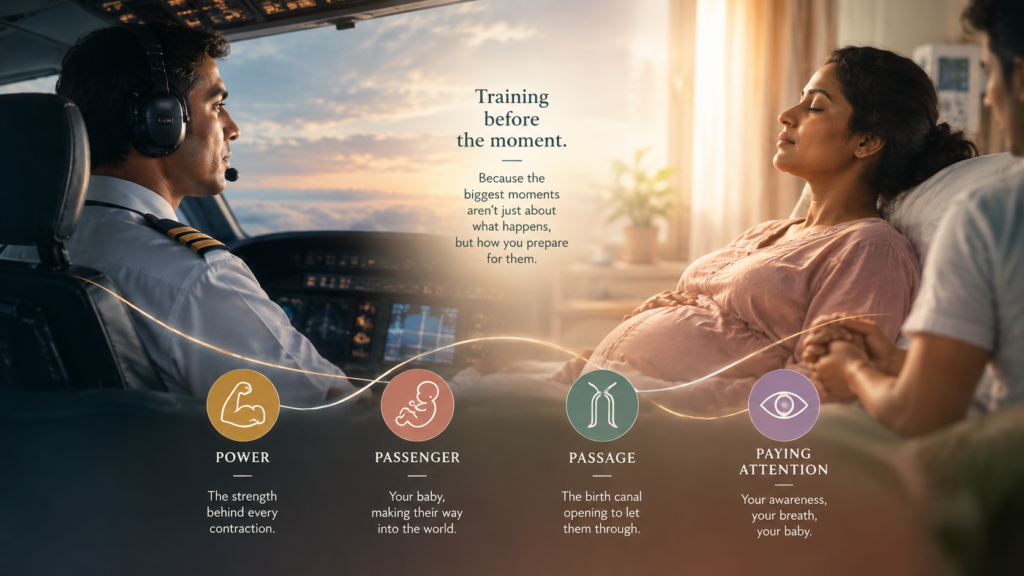
1. Alertness
Paying Attention
The moment something changed in that cockpit, Captain Smit noticed — not minutes later, not once it was obvious to everyone, but early, because he was paying attention before anything went wrong.
That’s the first lesson for labour. Your body has been sending you information throughout pregnancy, not just once contractions start. Paying attention means staying tuned in rather than tuned out, so that when labour truly begins, you’re not caught off guard — you’re ready.
2. The Instinct to Protect
Passenger
Captain Smit wasn’t flying for himself alone. A cabin full of passengers depended on him, and that responsibility sharpened his focus when it mattered most.
Your passenger is your baby. That fierce, almost primal desire to protect them isn’t a small thing — it’s one of the strongest forces in the room. When fear tries to take over during labour, that instinct is what carries you through it. Remember who you’re doing this for.
3. Opening the Door From Within
Passage
At the most critical moment, Captain Smit opened the cockpit door from the inside — reaching out, letting help in, rather than trying to manage the crisis entirely alone.
Your passage works the same way. The cervix has to open from within, and your role isn’t to force it — it’s to let it. Leaning on your medical team, your partner, your doula in that moment isn’t weakness. Like Captain Smit opening that door, it’s trust, not surrender.
4. Turning to the Mantra
Power — the inner kind
In a moment of extreme uncertainty, Captain Smit turned to something deeper than procedure. He turned to the Hanuman Chalisa.
That’s a kind of power no monitor can measure — the power of faith. A mantra, a prayer, a name repeated quietly under the breath: that inner anchor becomes real physical power during labour. It slows the breath, steadies the mind, and a steady mind lets the body do what it already knows.
5. One Last Push
Power — in action
Every crisis has its final, decisive moment — the one everything else was building toward. For Captain Smit, it was the choice he made in the last seconds.
For a labouring mother, that moment is the final push. Everything gathers into it — the alertness, the instinct to protect, the surrender of the passage, the strength drawn from faith. This is where Power stops being an idea and becomes action.
The Nation Noticed — And So Did Its Roots
What happened in that cockpit didn’t stay in that cockpit. The Prime Minister personally called Captain Smit to thank him for his presence of mind and told him to reach out directly if he ever needed anything.
He didn’t stop there. The PM also spoke with Captain Smit’s parents—thanking them and acknowledging the Sanskar they had given their son long before he ever stepped into a cockpit. The Chief Minister went a step further and met the family in person.
A nation can applaud the courage it sees in a crisis. But what it was really applauding, perhaps without even realizing it, was years of quiet upbringing no one had ever put a spotlight on—until that day.
Captain Smit’s story is remembered for a few extraordinary minutes. But we don’t see how much of those minutes was built long before—through training, through instinct, through a faith cultivated over years, quietly, long before it was ever needed.
Childbirth asks the same of you. You’re not expected to be fearless. You’re expected to stay aware, protect fiercely, open rather than resist, draw on something deeper than yourself, and when the moment arrives, push with everything you have.
Power. Passenger. Passage. Paying attention.
You already carry all four. Labor is simply where you’ll meet them.